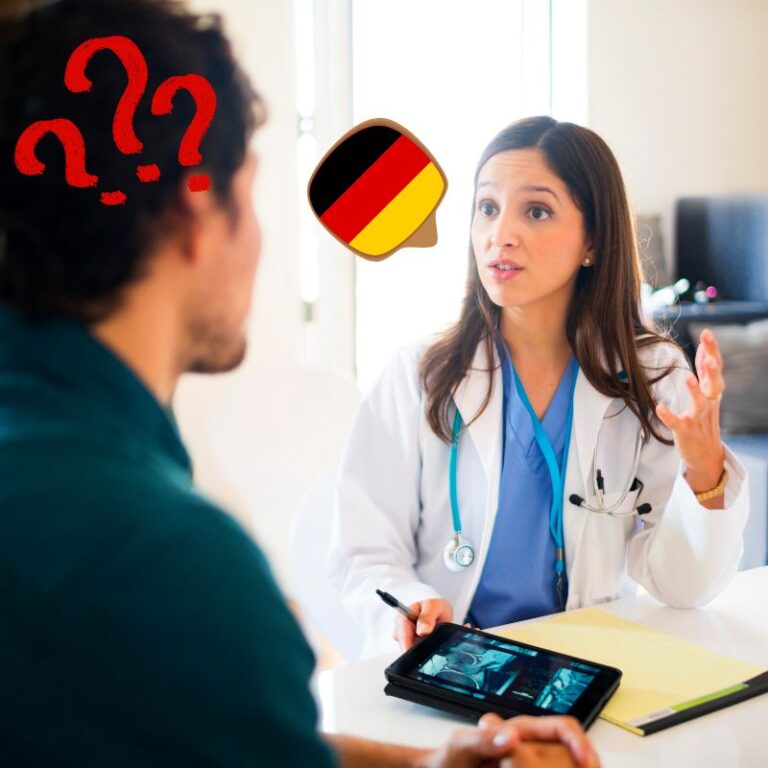
Why German is the key to everything Work, doctors, government agencies, school.
Many people come to Germany with good professional qualifications, university degrees, work experience, and motivation. And yet, they repeatedly encounter invisible barriers in everyday life. These barriers often have nothing to do with knowledge or intelligence, but with language.
In Germany, German is not just a means of communication. It is the key that opens or closes doors – at work, at the doctor’s, at government offices, and at their children’s schools.
Speaking German is different from knowing German.
A big misconception is the assumption that language skills automatically mean that you feel confident.
Many people have learned German, passed exams, understand texts, know grammar, and yet they don’t dare to speak, are afraid of making mistakes, get nervous in conversation, and freeze up in stressful situations. Especially in important moments at the doctor’s office, at the job center, or in a job interview, “a little German” is not enough. It’s not about perfect sentences, but about communicating under pressure.
Language determines employment opportunities
In Germany, language is a key criterion in professional life. Many employers openly say: “The qualifications are right, but the language skills are not.” This often does not refer to technical vocabulary, but rather to making phone calls, asking questions, clarifying misunderstandings, making small talk with colleagues, and giving and receiving feedback. Those who do not speak confidently are often underestimated. Good ideas remain unspoken. Opportunities are missed, not because you are incapable, but because you cannot express yourself.
Language also determines whether you get promoted, given responsibility, and taken seriously.
At the doctor’s office: Language provides reassurance
For many people, visits to the doctor are stressful situations. This stress is even greater when speaking a foreign language. Typical problems include: not being able to describe symptoms correctly, not understanding medical terms, fear of saying something wrong, and uncertainty about diagnosis or treatment. Many people nod politely even though they have not understood everything. This can be dangerous. Good language skills mean being able to ask questions, express uncertainty, understand treatments, and make informed decisions. Language is directly linked to health in this context.
Authorities: Language as a factor of power
For many newcomers, dealing with authorities is a major challenge. Letters, forms, and appointments seem complicated and impersonal.
Official language is often formal, indirect, and full of technical terms. Those who do not understand German well quickly feel helpless. Decisions seem final, even when there is room for maneuver. Language changes that one understands rights and obligations,
one can ask questions, one can explain why something is not possible, one can understand deadlines and notices. Language gives one the ability to act.
School and children: Language connects or divides
Parents want to support their children. But without German language skills, many feel helpless. Parent-teacher conferences, letters from school, discussions with teachers
Parent-teacher conferences. All of this takes place in German. When parents don’t speak the language, a distance develops. Children often take on responsibility early on, translating and explaining. This can be a burden.
Good German skills help parents support their children
Identify problems early on. Be part of the school community.
Integration often begins right here in everyday school life.
Integration ist mehr als Grammatik
Many people think of integration in terms of rules, laws, or citizenship. In reality, integration begins in everyday life.
Integration means having the confidence to speak, being understood, clearing up misunderstandings, and being part of conversations. Language is the tool for this.
Those who speak are seen.
Those who remain silent often remain invisible, even if they are capable of many things.
The fear of making mistakes
A major obstacle is the fear of making mistakes.
Many have learned: “I can only speak when it’s perfect.”
In Germany, perfection is less important than comprehensibility. Mistakes are part of the process. Most people know that German is difficult.
What is often lacking is not knowledge, but courage.
Everyday language is more important than formal German
Many language courses focus on grammar, tests, and exams. Everyday life is different. Short sentences, incomplete statements, questions, gestures, intonation.
In everyday life, communication counts, not correctness.
Those who learn to speak in a way that is suitable for everyday use will progress faster than those who get perfect test scores but are afraid of conversations.
Language changes your attitude towards life
As your language skills improve, many things change. You feel more independent, you understand humor, you can respond instead of just listening. You feel that you are being taken seriously.
Many people report that they only feel like they have truly arrived in Germany once they are able to express themselves linguistically.
Learning German is a process, not a goal
Learning German is not a project with a fixed end point. It is a process that is constantly evolving.
It’s not about being flawless, speaking without an accent, or sounding like a native speaker.
It’s about being understood and having the confidence to keep at it.
Conclusion: Language is the key to participation
German opens doors not because it has to be perfect, but because it creates connections.
Those who speak German understand more, become more confident, can make decisions, and feel less helpless.
Language is not a barrier, but a tool. And the more you use it, the better it works.
Integration does not begin with a form, but with a conversation.
About the Author
Anita Grabowski is an integration and career advisor for Indian IT-Professionals in Germany and founder of Germandia.
She supports highly qualified Indian talent who come to Germany with ambitions but are confronted with repeated job rejections, bureaucratic hurdles, and the pressure of obtaining a visa. Her work focuses on optimizing resumes according to German standards, structured application strategies, interview preparation, and practical guidance through the German system.
Anita combines clarity, structure, and cultural understanding to help her clients position themselves optimally in the German job market. Her approach reduces uncertainty, increases the chances of job interviews, and boosts self-confidence in one of the most important phases of moving and building a career.
Her book “Deutsch sprechen ohne Angst” (Speaking German Without Fear) reflects her belief that courage and drive are the foundation for long-term success in a new country.