If you are applying for jobs in Germany, understanding the hiring process can save you a lot of frustration.
Many international professionals expect the process to work the same way as in their home country. They submit a CV, wait for an interview and assume that strong technical experience will do the rest.
In Germany, the process can be more structured. Your CV, the relevance of your experience, how clearly you communicate your skills and how well you fit the specific role can all influence whether you move forward.
For Indian IT professionals, understanding what happens after you click “Apply” is especially important.
Hiring Process in Germany: Quick Answer
The hiring process in Germany typically starts with an application screening, followed by one or more interviews. Depending on the company and position, candidates may also complete a technical interview, case study, assessment or meet the future team.
If both sides decide to proceed, the company makes an offer and prepares an employment contract.
There is no single hiring process used by every German company. A startup may make a decision after two conversations, while a large corporation may have several interview and approval stages.
What You’ll Learn
In this article, you’ll learn:
- what happens after you submit your application
- how recruiters screen your CV
- what happens during the first interview
- why there may be several interview rounds
- what German employers evaluate beyond technical skills
- what happens before you receive an offer
- why the process can sometimes take longer than expected
- which mistakes international applicants should avoid
Table of Contents
- Application
- CV Screening
- Recruiter or HR Interview
- Technical or Hiring Manager Interview
- Second Interview
- Team Fit and Final Evaluation
- Salary and Contract
- Rejection or Offer
- What German Employers Are Really Evaluating
- Common Mistakes International Candidates Make
1. You Submit Your Application
The German hiring process begins before the recruiter ever speaks to you.
You find a position and submit the documents requested in the job advertisement.
Applications in Germany are now commonly submitted through company career portals or electronically. Depending on the position and company, employers may request a CV, cover letter, certificates or references. The official German government portal Make it in Germany recommends reading the job advertisement carefully because companies usually specify which documents they expect. (Make it in Germany)
This sounds obvious, but it is where the first mistakes begin.
Some candidates see:
Java Developer
and immediately apply.
But the job description may actually require:
- Java
- Spring Boot
- AWS
- German B2
- experience with a specific industry
- several years of relevant professional experience
The job title alone does not determine whether the position fits you.
Read the entire job description before applying.
2. CV Screening: The First Real Selection
Your application reaches HR, Talent Acquisition, a recruiter or sometimes directly the hiring department.
Now the first question is not:
“Is this person talented?”
It is:
“Does this profile fit the position we are trying to fill?”
This distinction matters.
A candidate can have 12 years of IT experience and still be rejected if the recruiter cannot quickly understand how that experience relates to the open position.
The recruiter may look for:
Relevant experience
Does your recent experience match the role?
Technical skills
Do you have the technologies mentioned in the job description?
Seniority
Are you applying at the appropriate level?
Career history
Is your professional development understandable?
Location
Are you already in Germany or applying from abroad?
Language
Does the position require German?
Work authorization
Can the company employ you directly, or will immigration steps be necessary?
This is why sending the same CV to dozens of unrelated positions is usually a weak strategy.
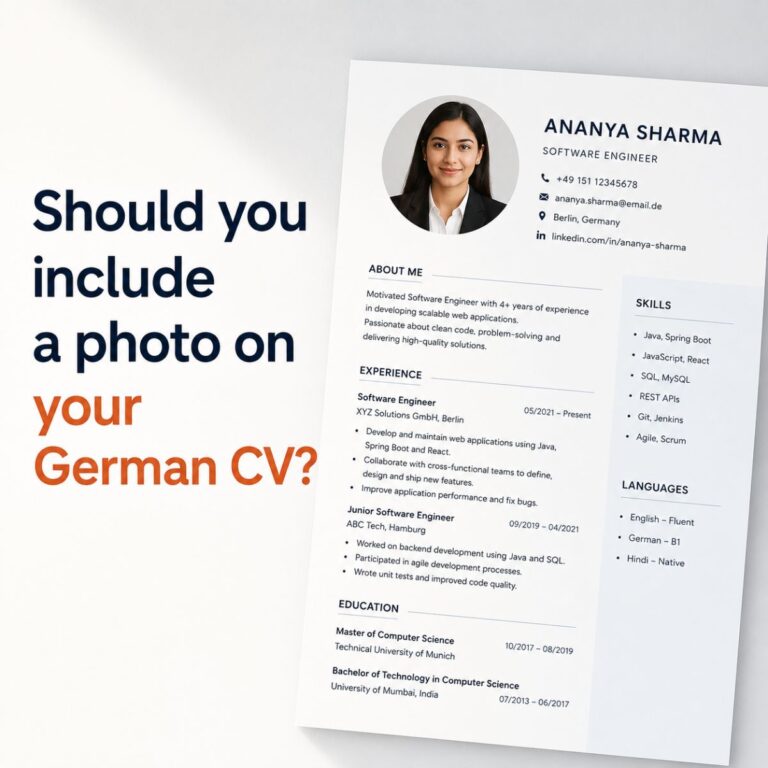
Your CV needs to tell one clear professional story.
3. The First Interview: Recruiter or HR
If your application passes the initial screening, the next step is often a conversation with HR or a recruiter.
This may be a relatively short video or telephone interview.
The purpose is usually not to test every technical skill you have.
The recruiter wants to understand the basics.
For example:
Why are you interested in this position?
Why this company?
What are you currently doing?
Why are you looking for a new job?
When could you start?
What are your salary expectations?
Where are you located?
What is your German level?
What is your work authorization status?
For international applicants, this conversation is important.
Your answers should be clear and direct.
If someone asks:
“Why are you interested in this position?”
they usually do not need your entire professional history.
They need to understand why this particular job makes sense for you.
4. The Technical or Hiring Manager Interview
If HR sees a potential fit, the next interview may be with the hiring manager, technical lead or future supervisor.
Now the questions become more specific.
For an IT position, you may be asked about:
- technologies you have actually used
- projects you worked on
- architecture or systems
- technical decisions
- problems you solved
- your individual responsibilities
- collaboration with other teams
- failures and lessons learned
There may also be a technical test, coding task, case study or presentation.
The exact selection process varies by employer. Some German companies also use assessment centres, particularly for certain positions or larger selection processes. The official Make it in Germany portal describes assessment centres as a selection method that can include group discussions, role plays and presentations. (Make it in Germany)
Hiring Process in Germany: Do Not Just List Technologies
This is particularly important for experienced IT professionals.
Imagine your CV says:
Java | AWS | Kubernetes | Docker | Python | Azure | Jenkins | Terraform
The interviewer asks:
“Tell me about your Kubernetes experience.”
A weak answer is:
“I have worked with Kubernetes for three years.”
A stronger answer explains:
where you used it, what problem you were solving, what your responsibility was and what happened as a result.
German employers do not only want to know which technologies appear on your CV.
They want to understand what you actually did with them.
5. Why Is There Sometimes a Second Interview?
A second interview does not necessarily mean the first interview went badly.
Often the opposite is true.
Different people inside the company need different information before making a hiring decision.
For example:
HR may evaluate motivation, salary expectations and general suitability.
The hiring manager evaluates your professional experience.
Technical colleagues evaluate your technical competence.
Future team members may want to understand how you communicate and collaborate.
For senior positions, additional managers or decision-makers may also become involved.
This is why you may tell parts of your professional story more than once.
Do not become irritated by this.
The people in the second interview may not have participated in the first one.
6. Team Fit Is Not a Small Detail
Technical skills can get you into the interview.
They do not automatically get you the job.
The company also needs to imagine working with you every day.
They observe things such as:
Can you explain complex topics clearly?
Do you listen?
Can you admit when you do not know something?
How do you respond to criticism?
Can you disagree professionally?
Do you take responsibility?
Can you work independently?
How do you communicate problems?
This is where cultural differences can become important.
You do not need to become “German.”
But you need to understand the professional environment you are entering.
In many German workplaces, clear communication, reliability, preparation and taking responsibility for your own tasks are highly valued.
7. The Waiting Period
This part frustrates many candidates.
You finish an interview.
You think it went well.
Then:
Nothing.
Three days.
One week.
Sometimes longer.
This does not automatically mean rejection.
There may still be other interviews, internal discussions, budget approvals, holidays, illness or several people involved in the decision.
Experiences shared by applicants in Germany also show that waiting between interview rounds can sometimes be surprisingly long. This varies enormously between employers, so there is no universal German timeline. (Reddit)
The important rule is:
Do not stop your job search because one interview went well.
Until you have a written offer or signed contract, continue applying.
8. Salary, Offer and Employment Contract
If the company decides that you are the right candidate, you may first receive a verbal offer or an email.
The written employment contract follows.
Read it carefully.
Important points include:
- salary
- working hours
- starting date
- vacation
- workplace or remote-work arrangements
- notice period
- probationary period
- fixed-term or permanent employment
The Federal Employment Agency explains that a German employment contract should specify important employment conditions such as working hours, start date, holiday entitlement and any agreed probationary period. (Bundesagentur für Arbeit)
Do not resign from your current job simply because someone tells you:
“We would like to hire you.”
Wait until the conditions are clear and you have the appropriate written documentation.
9. The Hiring Process Does Not Always Look the Same
There is no universal sequence such as:
Application → HR → Technical Interview → Offer.
You might experience:
Small company
Application → CEO interview → technical discussion → offer
Medium-sized company
Application → HR → hiring manager → team interview → offer
Large corporation
Application → recruiter → technical interview → second interview → management approval → HR → offer
Some companies may also invite candidates to an on-site meeting, assessment or trial day depending on the role. The Federal Employment Agency notes that trial work or practical assessments are used in various fields and can allow both the employer and candidate to evaluate the fit. (Bundesagentur für Arbeit)
The number of interviews therefore tells you very little by itself.
What matters is understanding what the company is evaluating at each stage.
Hiring Process in Germany: Key Takeaway So Far
The German hiring process is not simply about proving that you are technically qualified.
At every stage the employer is reducing uncertainty:
Can this person do the job?
Does their experience match what we need?
Can they communicate clearly?
Will they work well with the team?
Do they understand the position?
Can we realistically employ them?
10. Common Mistakes International Candidates Make
Understanding the hiring process is useful. But knowing what can go wrong is just as important.
Here are some of the mistakes I repeatedly see when international professionals apply in Germany.
Hiring Process in Germany: Applying to Too Many Different Roles
One CV should not try to sell you as:
Software Developer
Data Analyst
Project Manager
Scrum Master
Cloud Engineer
Business Analyst
all at the same time.
You may have experience in several areas. But the recruiter is hiring for one specific position.
Your application should make it immediately clear why you fit that role.
Hiring Process in Germany: Applying Without Reading the Job Description
Do not apply simply because the job title looks familiar.
Read:
the responsibilities
required technologies
years of experience
language requirements
location
industry requirements
mandatory qualifications
Separate must-have requirements from things that are merely preferred.
You do not need to match every sentence of a job description. But you should understand where you match and where you do not.
Hiring Process in Germany: Using the Same CV for Every Application
Your professional history does not change.
But what you emphasize should.
If a position requires AWS and you have strong AWS experience, the recruiter should not have to search page two of your CV to discover it.
Make relevant experience easy to find.
Hiring Process in Germany: Giving Very Long Interview Answers
More information does not automatically make an answer better.
If an interviewer asks:
“What was your responsibility in this project?”
answer that question first.
Do not begin with the history of the company, explain every member of your team and spend five minutes getting to your actual responsibility.
Clear answers make you easier to understand.
Hiring Process in Germany: Not Preparing Questions
An interview is not an interrogation.
You are also deciding whether you want to work for this company.
Prepare meaningful questions about:
the position
the team
expectations
technologies
current challenges
onboarding
the next steps in the hiring process
Good questions show that you have thought seriously about the position.
11. What Should You Do After an Interview?
At the end of the interview, ask:
“What are the next steps in the hiring process?”
This gives you an idea of the expected timeline.
A short thank-you message after the interview can also be appropriate. Keep it simple and professional.
If the company tells you that you will hear back within one week and you have received nothing after that period, a polite follow-up is reasonable.
For example:
Thank you again for our conversation regarding the [Position] role. I remain very interested in the opportunity and wanted to ask whether there is an update regarding the next steps in the hiring process.
Then continue with your other applications.
Do not make one company the centre of your entire job search.
12. Why Was I Rejected Even Though the Interview Went Well?
This is one of the hardest parts of job searching.
You can have a good interview and still receive a rejection.
Perhaps another candidate had more relevant experience.
Perhaps someone spoke German.
Perhaps an internal candidate appeared.
Perhaps salary expectations did not match.
Perhaps the company changed its hiring plans.
Perhaps another candidate simply fitted this particular team or project better.
A rejection therefore does not automatically mean:
“I am not good enough.”
But repeated rejection at the same stage can give you useful information.
If you send 50 applications and receive no interviews, investigate your:
CV
role selection
positioning
job matching
If you regularly reach the first interview but never the second, investigate your:
answers
communication
motivation
salary expectations
interview preparation
If you repeatedly reach final interviews but receive no offer, look more closely at:
technical performance
team fit
communication
final interview strategy
Do not only count rejections.
Look for patterns.
That is where useful information is hidden.
13. How Long Does the Hiring Process in Germany Take?
There is no fixed timeline.
Some companies hire quickly. Others need several weeks or longer.
The process depends on:
company size
number of interview rounds
number of candidates
availability of decision-makers
internal approvals
urgency of the vacancy
This is why you should have several applications running at the same time.
Do not wait for Company A before applying to Company B.
Hiring Process in Germany: Key Takeaways
The hiring process in Germany varies between companies, but the basic principle remains similar.
Your application must first show a clear match with the position.
Passing the CV screening does not mean you have the job. Each interview stage answers a different question.
Technical knowledge matters, but employers also evaluate communication, motivation, reliability and how you might work within the team.
Read job descriptions carefully.
Apply selectively.
Prepare for every interview.
Keep your answers clear.
Continue applying while other hiring processes are running.
And most importantly:
Do not start learning how the German hiring system works after 50 rejections. Learn it before you start applying.
Hiring Process in Germany: Frequently Asked Questions
How many interviews are normal in Germany?
There is no fixed number. Some companies make a decision after one or two interviews, while larger organisations may have several stages involving HR, hiring managers, technical specialists and future team members.
How long should I wait after a job interview in Germany?
Follow the timeline given by the recruiter or interviewer. If they said they would contact you within a week and that period has passed, you can send a short, polite follow-up.
Is German required to get a job in Germany?
Not for every position. Some international companies and IT teams work primarily in English.
However, German can significantly increase the number of positions available to you, particularly when communication with German-speaking colleagues, customers or stakeholders is part of the role.
Do not assume that working in IT automatically means German will never matter.
Do German companies use ATS software?
Many companies use applicant tracking systems to organise applications and recruitment workflows.
But you should not build your entire application strategy around trying to “beat the ATS.”
Your CV still needs to be relevant, clear and understandable to the people involved in the hiring decision.
Should I send a cover letter in Germany?
Check the job advertisement.
If a cover letter is requested, send one.
If it is optional, decide whether it gives you an opportunity to explain something useful that your CV cannot communicate clearly.
Do not send a generic letter simply because you believe every German application requires one.
Can I apply for jobs in Germany from India?
Yes.
But applying internationally introduces additional questions such as relocation, visa or residence requirements, availability and sometimes German-language expectations.
Research these requirements before starting a large application campaign. The official German government portal Make it in Germany provides information for international professionals about working and moving to Germany.
How Germandia Can Help
Germandia helps Indian IT professionals understand the German job market before mistakes cost them interviews.
The focus is not simply on making a CV look better.
It is about understanding:
which roles actually fit your profile
how German recruiters read your application
how to position your experience clearly
how to analyse job descriptions
how to prepare for interviews
how language and cultural differences affect your career
Because getting a job in Germany starts long before the interview.
Final Thoughts
Germany needs skilled professionals, but qualifications alone do not guarantee a successful application.
You need to understand the system you are entering.
A strong candidate who applies to the wrong positions with an unclear CV can struggle.
A candidate who understands their professional positioning, chooses suitable roles and communicates their experience clearly gives recruiters something much easier to evaluate.
That is the difference between simply sending applications and having an application strategy.
Hiring Process in Germany: Ready to Prepare for the German Job Market?
Understand the system before you apply.
Explore Germandia
About the Author
Anita Grabowski is an integration and career advisor for Indian IT professionals in Germany and founder of Germandia.
She supports highly qualified Indian talent who come to Germany with ambitions but are confronted with repeated job rejections, bureaucratic hurdles and the challenges of understanding the German system.
Her work focuses on CV optimization according to German standards, application strategy, interview preparation and practical guidance through the German hiring process.
Speak German Without Fear
Anita is also the author of “Speak German Without Fear”, a practical book based on the method she developed while learning German herself. It helps learners integrate German into everyday life, build vocabulary and gain confidence in actually speaking the language.
Related Articles
Continue reading:
Get Job in Germany
A practical step-by-step approach to finding and applying for jobs in Germany.
ATS CV Germany
Learn how applicant tracking systems work and how to create a CV that works for both recruiters and ATS software.
German CV vs Indian CV
Discover the most common reasons qualified Indian IT professionals struggle to get interviews in Germany.
Sources
- Make it in Germany – Applying for a Job
Official German government portal covering application documents, interviews and assessment centres. - Federal Employment Agency – How Can I Find a Job in Germany?
Official information about applications, selection procedures, interview processes and application timelines in Germany. - Federal Employment Agency – Working in Germany
Official information for international professionals about German language, qualifications, job search and visa requirements. - Federal Employment Agency – Fair Migration
Official information about employment contracts and working conditions in Germany.