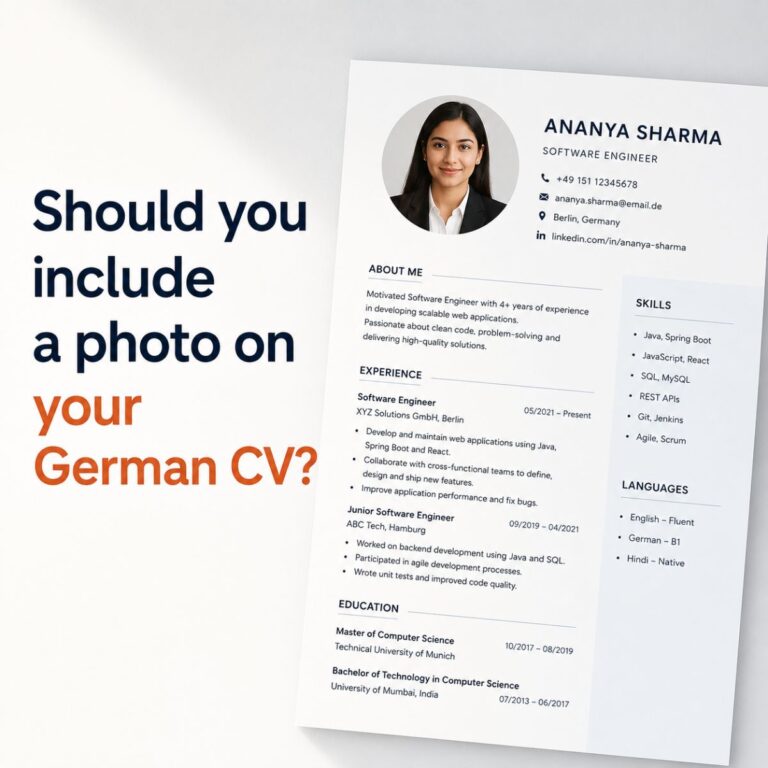
If you are an Indian IT professional applying for jobs in Germany, one of the biggest mistakes you can make is using the same CV that worked in India. German recruiters and hiring managers evaluate applications differently, and even highly qualified candidates are often rejected because their CV does not match German expectations.
Quick Answer
A German CV is not simply a translated Indian CV. German recruiters expect a concise, well-structured document tailored to a specific position. Many Indian CVs contain unnecessary information, are too general and are not adapted to the job description. Understanding these differences can significantly increase your chances of getting interviews in Germany.
Why This Topic Matters
Every year, thousands of highly qualified Indian IT professionals come to Germany or apply for German jobs from abroad. Many have impressive technical skills, years of experience and excellent academic qualifications.
Yet countless applications are rejected before reaching the interview stage.
Most candidates assume the problem is their German language level, their visa status or the difficult job market.
Sometimes that is true.
But very often, the first obstacle is much simpler.
Their CV tells the wrong story.
One of the biggest misunderstandings is believing that a good CV is universal. It isn’t.
A CV that works perfectly in India may not work in Germany because recruiters look for different things.
German recruiters do not spend several minutes analysing every application. In many cases, they spend only a few seconds deciding whether to continue reading or move on to the next candidate.
That is why clarity matters more than complexity.
German Recruiters Do Not Read Your CV Like Indian Recruiters
Many international candidates imagine that recruiters carefully study every sentence.
In reality, this rarely happens.
German recruiters usually scan a CV first.
They look for answers to questions such as:
- Does this candidate fit the role?
- Is the career path logical?
- Does the experience match the job description?
- Can I immediately understand what this person actually does?
- Is this CV easy to read?
If they cannot answer these questions within seconds, they often continue with the next application.
This is not because the candidate lacks qualifications.
It is because the CV makes understanding those qualifications unnecessarily difficult.
A German CV Focuses on Relevance, Not Quantity
One of the biggest differences between Indian and German CVs is the amount of information.
Many Indian CVs include almost everything:
- detailed personal information
- long career objectives
- every training course
- every project
- every technology ever used
- long descriptions of responsibilities
German recruiters usually expect something different.
They ask one simple question:
Is this information relevant for the position I am hiring for?
Everything that does not help answer that question weakens the application.
This does not mean you should hide your experience.
It means you should present it strategically.
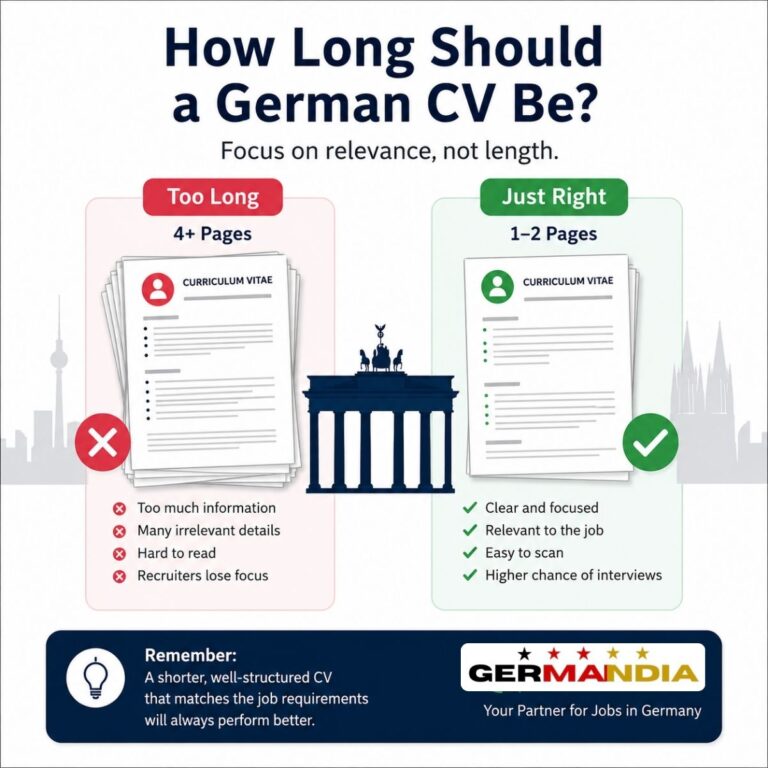
A focused two-page CV that clearly matches the vacancy is usually far stronger than a four-page CV covering every detail of your career.
The Biggest Mistake: One CV for Every Application
This is probably the mistake I see most often.
Many candidates create one CV and send it to dozens or even hundreds of companies.
It feels efficient.
Unfortunately, it is rarely effective.
Every German job advertisement is different.
One company may be looking for strong stakeholder communication.
Another focuses on cloud technologies.
A third values leadership experience more than technical expertise.
If your CV remains identical for every application, it is unlikely to highlight what that particular employer considers important.
A successful German CV is not written once.
It is adapted every time you apply.
Your CV Should Tell One Clear Story
Another common mistake is trying to impress recruiters by showing everything you have ever done.
Imagine a candidate whose CV includes:
- Software Development
- Data Analysis
- Machine Learning
- Project Management
- GIS
- Research
- Teaching
- Product Management
Individually, these are valuable skills.
Together, they often create confusion.
A recruiter quickly starts wondering:
„Which position is this person actually applying for?“
A strong German CV tells one clear story.
It answers one important question:
Why are you the right person for this specific role?
Everything else becomes secondary.
Why Positioning Matters More Than Qualifications
Many international IT professionals believe their degrees and certifications will speak for themselves.
Unfortunately, they don’t.
German employers are not buying qualifications.
They are hiring someone who can solve a specific problem.
That means your CV should position you as the solution.
For example:
Instead of presenting yourself as someone who has experience in ten different areas,
show that you are an experienced Data Engineer, SAP Consultant, Cloud Engineer or Software Developer whose experience perfectly matches the advertised position.
Specialisation creates confidence.
Trying to be everything for everyone usually creates uncertainty.
German Recruiters Want Clarity
Many candidates think adding more information makes their CV stronger.
The opposite is often true.
Recruiters appreciate clarity.
They want to understand your profile without effort.
That means:
- clear job titles
- logical career progression
- easy-to-read formatting
- concise descriptions
- measurable achievements where possible
- information relevant to the vacancy
The easier your CV is to understand, the easier it becomes for a recruiter to invite you to an interview.
An Indian CV Is Often Written Chronologically. A German CV Is Written Strategically.
This is an important difference.
Many Indian professionals simply document everything they have done throughout their career.
A German CV is not only a record of your past.
It is a marketing document.
Its purpose is not to tell your life story.
Its purpose is to convince a recruiter that you are the right candidate for one specific position.
That changes the way information should be presented.
Experience should be prioritised according to relevance.
Skills should support your target role.
Projects should demonstrate value.
Every section should answer one question:
Why should this company invite me for an interview?
Quality Always Beats Quantity
Some candidates believe that adding more certificates, more technologies and more responsibilities automatically creates a stronger application.
In reality, recruiters often remember one thing:
Whether your profile clearly fits their vacancy.
A focused CV with relevant experience usually performs much better than a long document trying to impress with volume.
Sometimes removing information makes a CV significantly stronger.
German CV vs Indian CV: The Differences That Really Matter
There is no single „perfect“ German CV. Different companies have different expectations. However, after looking at hundreds of applications and speaking with both candidates and recruiters, certain patterns appear again and again.
Understanding these differences can help you avoid common mistakes before you send your next application.
German CV vs Indian CV
| German CV | Indian CV |
|---|---|
| Tailored for each job | Often one CV for many applications |
| Usually 1–2 pages | Often 2–4 pages or longer |
| Focuses on relevance | Includes almost everything |
| Clear positioning for one role | Multiple different career directions |
| Short, achievement-focused descriptions | Long responsibility-focused descriptions |
| Recruiter-friendly layout | Dense information |
| Adapted to the job description | Generic content |
| Marketing document | Career history |
Neither approach is „wrong.“
They simply reflect different recruitment cultures.
The problem begins when candidates use an Indian-style CV for the German market without adapting it.
Should You Change Your Entire CV?
Not necessarily.
Many candidates believe they need to rewrite everything from scratch.
Usually, that is not true.
Very often, your experience is already strong enough.
The challenge is presenting it differently.
Instead of asking:
„How can I add more information?“
Ask yourself:
„Which information helps me get this particular job?“
That simple shift changes everything.
Common Mistakes I See Again and Again
After reviewing many CVs from international IT professionals, I repeatedly notice the same problems.
Using one CV for every application
Every vacancy is different.
Your CV should reflect the requirements of the position you are applying for.
Applying without understanding the job description
Many candidates read only the job title.
German recruiters expect you to understand the entire advertisement.
Every important requirement should be reflected somewhere in your application if it genuinely matches your experience.
Trying to impress with everything
Listing every technology, every certification and every project often has the opposite effect.
Instead of looking experienced, the profile becomes unclear.
Writing responsibilities instead of achievements
Recruiters already know what a Software Engineer or Data Analyst generally does.
What they want to know is:
What did you achieve?
Whenever possible, include measurable results.
Ignoring positioning
If your CV leaves recruiters wondering what role you actually want, your chances of receiving an interview decrease significantly.
One CV should tell one clear story.
Is AI Enough to Optimise Your CV?
AI tools can be useful.
They can improve grammar, suggest better wording and help organise information.
However, they cannot fully understand the context of your application.
An AI tool usually does not know:
- which company you are applying to
- how that company hires
- which skills matter most for that specific role
- what the recruiter is likely to prioritise
- what should be emphasised or removed
That is why AI should support your application, not replace professional judgement.
A successful German CV is not only well written.
It is strategically adapted to a specific employer.
Remember: Recruiters Hire for One Position
Recruiters are not looking for the most impressive person.
They are looking for the most suitable person.
These are not always the same.
Sometimes a candidate with ten years of experience is rejected because their CV does not clearly match the role.
Meanwhile, someone with fewer years of experience receives an interview because their application immediately answers the recruiter’s questions.
Clarity wins.
Key Takeaways
- A German CV is not simply a translated Indian CV.
- Tailor your CV to every job application.
- Focus on one clear target position.
- Relevance is more important than quantity.
- Recruiters scan your CV before they read it.
- Positioning often matters as much as qualifications.
- AI can support your CV but cannot replace a company-specific strategy.
Frequently Asked Questions
Can I use the same CV in Germany that I used in India?
Usually not. Your CV should be adapted to German recruiter expectations and to the specific job advertisement.
How long should a German CV be?
For most professionals, one to two pages are sufficient.
Should I customise my CV for every application?
Yes. One of the biggest mistakes is sending the same CV to every company.
Is Europass recommended in Germany?
Some employers accept it, but many recruiters prefer a cleaner, more modern layout.
Can AI optimise my CV?
AI can improve language and formatting, but it cannot fully adapt your CV to a specific company or vacancy.
Why am I getting rejected despite having strong experience?
In many cases, the problem is not your qualifications but how your experience is presented and positioned.
Do German recruiters read every CV carefully?
Usually, they scan the CV first. If your profile is not immediately clear, they may continue with the next application.
Should I include every project I have worked on?
No. Include the projects that best support your target position.
Final Thoughts
Many Indian IT professionals believe that getting a job in Germany is mainly about technical skills.
Technical skills are important.
But they are only one part of the equation.
German recruiters want to understand, within seconds, whether you are the right person for their specific vacancy.
Your CV is not simply a document.
It is your personal marketing tool.
When it clearly communicates your value, highlights your most relevant experience and speaks the language of German recruiters, your chances of receiving interviews increase significantly.
Ready to Improve Your German CV?
If you are applying for IT jobs in Germany but not getting interviews, the problem may not be your qualifications.
It may be your CV strategy.
Start with a Free CV Diagnosis and find out what German recruiters may be seeing when they read your application.
Or explore the German Job Application Guide to learn how successful applications are built for the German market.
Sources
- DAAD – https://www.daad.de
- Make it in Germany – https://www.make-it-in-germany.com
- Bundesagentur für Arbeit – https://www.arbeitsagentur.de
- Destatis – https://www.destatis.de
About the Author
Anita Grabowski is the founder of Germandia. She helps Indian and other international IT professionals understand the German hiring process, optimize their CVs and application strategy, and increase their chances of getting hired in Germany.