Sometimes you discover an opportunity completely by chance and only afterwards realise how valuable it was. That is exactly what happened to me with the 8th German Indian Business Summit 2026 in Bremen.
I had not known about the event before and discovered it shortly before it took place through LinkedIn. When I saw that people from business, politics, academia and the German-Indian community would come together, I immediately became curious. India and Germany have become such an important part of my work that I decided I had to be there.
So on 20 August 2026, I travelled to Bremen with around 20 copies of my book Speak German Without Fear – The DSOA Method in my bag. I was excited and had no idea who I would meet, what conversations I would have or whether anyone would be interested in hearing about Germandia.
By the end of the day, my books were gone, I had met many interesting people and several conversations had confirmed something I have been thinking about for a long time: we need to prepare international professionals much better for the reality of working and living in Germany.
What is the German Indian Business Summit?
The German Indian Business Summit, GIBS, is an annual platform connecting policymakers, business leaders, executives, innovators and academics from Germany and India.
The 8th German Indian Business Summit took place on 20 August 2026 at Hochschule Bremen. It was organised by the German Indian Business Society in association with Bremen’s Ministry of Economic Affairs, Ports and Transformation and the Consulate General of India in Hamburg.
The theme of GIBS 2026 was:
“Germany and India as Strategic Partners: Industrial Transformation, Innovation and Talent in a Changing Global Economy.”
The program included industrial transformation, AI and automation, green technologies, sustainable energy, global supply chains and cross-border skilled talent mobility. The organisers described one of the central areas as the “Talent Bridge”, focusing on skilled professional mobility and cross-border workforce strategies.
This was naturally particularly interesting to me because it is closely connected to what I have been observing through my work with Indian professionals in Germany.
Bringing qualified people to Germany is important, but from my experience we also need to ask whether they actually know what awaits them once they arrive. Are they prepared for the German labour market? Do they understand how applications work? Have they started learning German? And do they have realistic expectations about working and living here?
These questions have become increasingly important in my work with Germandia.
Thank you to Dr. Rajesh Mishra
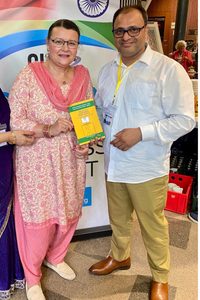
I would especially like to thank Dr. Rajesh Mishra and everyone involved in organising GIBS.
Dr. Mishra describes himself as a bridge-builder between India and Germany and is one of the people closely involved in the German Indian Business Summit. GIBS itself has developed into a platform bringing together people from diplomacy, politics, business and academia who are interested in strengthening German-Indian cooperation.
What impressed me personally was not only the programme but also the atmosphere of the event. Despite having so many guests from different professional backgrounds, it felt welcoming and personal. It was easy to approach people, introduce yourself and start a genuine conversation.
I did not have the feeling that everyone was simply collecting business cards. People were interested in hearing what others were doing, sharing their experiences and making connections.
The hospitality was wonderful, and of course I have to mention the food. It was delicious and contributed to the relaxed atmosphere of the whole day.
Considering that I discovered GIBS completely by chance, I am especially happy that I decided to go. The next event is already in my calendar.
German Indian Personalities 2026
One of the special parts of the summit was the recognition of the German Indian Personalities 2026.
The recognition honours people whose work contributes to strengthening German-Indian relations across business, culture, education, innovation and community engagement.
The personalities selected for 2026 included Abbas Khan, Anjana Singh, Dr. Bala Subramanian Ramani, Bharat Chaudhary, Bhavya Madan, Karan Singh, Lalit Mamtani, Lakshmi Lalita Mohan, Mallik Rao, Mithun Parambath, Neena Hartmann, Pranjal Kothari, Prof. Peter Kabel and Dr. Yojna Sah Jain.
I found this part of the event particularly interesting because it showed how many different ways people can contribute to the relationship between India and Germany. This connection is not built only through governments or large corporations. Education, culture, entrepreneurship and community engagement also play an important role.
One of the personalities recognised was someone very special to me.
Meeting my Hindi teacher Anjana Singh again
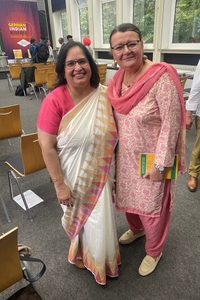
Anjana Singh is my Hindi teacher, and I had not seen her personally for quite some time. Meeting her again in Bremen was therefore a wonderful surprise, and seeing her recognised as a German Indian Personality 2026 made me particularly happy.
Anjana is connected with New2 GmbH, AMIKAL Center for Educational & Cultural Exchange e.V. and Hindi education. Her work combines integration, education and cultural exchange, all areas that are important when people move between India and Germany.
I have always appreciated Anjana not only because she is an excellent Hindi teacher, but also because she genuinely wants to help people.
It was quite special to think about how we originally met. She was teaching me Hindi, and now we were standing together at a summit dedicated to relations between India and Germany while my own work has increasingly developed in exactly this direction.
I was very happy that we had the opportunity to see each other again and even happier to see her work recognised in this way.
Presenting my book at GIBS

I also decided to take around 20 copies of my book “Speak German Without Fear – The DSOA Method” with me.
I did not know beforehand how much interest there would be. I simply wanted to use the opportunity to introduce the book, explain why I had written it and give copies to some of the people I met.
To my surprise, within a very short time almost all the copies were gone.
That meant a lot to me because the book is closely connected to something I have observed repeatedly among international professionals in Germany. Many people spend years learning German, studying grammar and preparing for examinations, but when they actually have to speak, they are still afraid of making mistakes.
My book therefore focuses strongly on motivation and on explaining why German is so important when someone wants to build a career and a life in Germany. It encourages people to use the language in everyday situations rather than waiting until they believe their German is finally perfect.
The method is also based partly on my own experience of learning German. I know what it means to live in a country whose language is not your native language, and I know there is a big difference between studying a language and actually using it every day.
For international professionals, German influences much more than the ability to have a conversation. It can affect professional opportunities, communication with colleagues, everyday independence, social contacts and the feeling of really being part of life in Germany.
Anjana even took some additional copies with her because she has a contact connected to a library. She also told me about an upcoming project where books can be presented and said that she would invite me when the opportunity comes.
I arrived in Bremen with around 20 books in my bag and left without them. I certainly had not expected that, and the interest in the book made me very happy.
Meeting people from politics, diplomacy and business
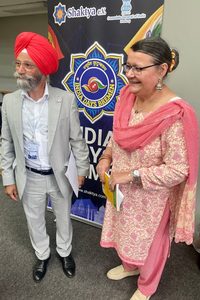
One of the things that made GIBS so valuable was the variety of people attending.
Shri Raakesh Natraj, Consul General of India in Hamburg, joined GIBS 2026 as Guest of Honor. The summit also brought together policymakers, business leaders, academics, innovators and members of the German-Indian community.
For me, these encounters matter because the questions I am dealing with through Germandia cannot be solved by candidates alone. They involve universities, employers, recruiters, language learning, integration, institutions and political decision-makers.
The more people I speak to from these different areas, the better I understand where the gaps actually are.
A conversation with a recruiter gave me another perspective

One of my most interesting conversations that day was with a recruiter working with international talent.
We spoke about the difficulties Indian professionals experience when looking for work in Germany, and she confirmed something I have observed for a long time: insufficient German language skills can significantly limit candidates‘ opportunities.
I found this exchange particularly valuable because I normally see the situation from the candidate’s perspective. People send me their CVs, tell me about unsuccessful applications and ask why they are not finding jobs despite having good qualifications.
A recruiter sees the other side and knows what employers are looking for and where candidates may be losing opportunities.
Our conversation gave me a lot to think about, and I want to write about it separately because the subject deserves more than a few sentences in an event report.
Meeting Yashu and hearing a different story
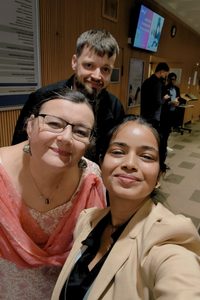
I also met a young Indian woman named Yashu, who works in the healthcare sector.
Her experience caught my attention because she had already applied for work in Germany while she was still living in India and successfully secured a position before coming here.
I found her story particularly interesting because I spend a lot of time hearing about unsuccessful applications. It is equally important to look at people who succeeded and understand how they approached their move to Germany, how they prepared themselves and what other professionals might learn from their experience.
I would like to tell more of Yashu’s story in another article because real experiences like hers can be extremely useful for other people planning to come to Germany.
Why these conversations matter to me
I started helping Indian professionals privately around 2019, long before Germandia existed.
Over the years, more and more people contacted me. They showed me their CVs, told me about their applications and shared their frustration when they repeatedly received rejections despite being well qualified.
Eventually, these experiences led to Germandia.
At first, I thought that CV optimisation and application support were the main areas where I could help. The more cases I analyse, however, the more I realise that the problem is often much bigger.
Many Indian professionals I meet have bachelor’s or master’s degrees and several years of professional experience. Their lack of qualifications is not necessarily the reason they struggle.
Some tell me they have sent 100, 200 or even 300 applications without finding a job. Others have been invited to several interviews and still receive rejection after rejection. If someone has already reached four or five interviews, it is difficult to argue that the CV alone is the problem because it has already succeeded in getting that person through the first selection.
I have also noticed that many candidates have difficulty reading job advertisements carefully and deciding whether a position actually matches their experience. Instead of having a clear professional positioning and applying selectively, they often apply to many different types of jobs.
When I look at the entire process, I see professional positioning, understanding job advertisements, knowledge of German recruitment processes, interview communication, employer expectations, language and cultural differences all playing a role.
A better CV can help, but it cannot solve all of these problems.
I believe preparation has to start earlier
This has led me to a question that increasingly occupies my work: Why do we wait until people are already in Germany and struggling before we prepare them for the reality of living and working here?
Many people invest a considerable amount of money and time in coming to Germany. They leave their families, move to another country, complete degrees or search for jobs and only later discover things they could have known much earlier.
I believe that much of this preparation should begin before they leave India.
Someone planning to study or work in Germany should have a realistic understanding of the German labour market. They should know how applications work, how to identify positions that genuinely match their profile and what German employers expect.
They should also understand why learning German early is so important. This does not mean that everyone needs perfect German before arriving, but arriving with a foundation that can be developed further in Germany is very different from starting from zero after arrival.
Preparing people honestly for Germany does not mean discouraging them from coming. I believe it gives them a much better chance of succeeding once they are here.
How Germandia is developing
These experiences have changed my idea of what Germandia should become.
I am currently working on a Germandia Academy designed to prepare Indian professionals for work and life in Germany more broadly than CV optimisation alone.
I also plan to travel to India and speak directly to students and professionals at universities. I want to reach people before they make important decisions about moving to Germany and explain what they can already do in India to prepare themselves.
Language is one part of this preparation, but so are understanding the German labour market, applications, professional positioning and developing realistic expectations about life in Germany.
At the same time, I have realised that I cannot close such a large gap alone. For this reason, I have contacted many organisations, institutions and politicians to make them aware of the problems I see through my work and the experiences Indian professionals have shared with me.
After many attempts, I have now actually received an invitation for a personal meeting at the Senate Chancellery of the Free and Hanseatic City of Hamburg.
For me, this is an important opportunity to bring these experiences into an institutional conversation and discuss how Indian students and professionals could be better prepared before and after coming to Germany.
I am very curious to see what comes out of this conversation, and I will report separately about my meeting at the Hamburg Senate Chancellery.
Why events like GIBS matter
One of the official focus areas of GIBS 2026 was cross-border skilled talent mobility. The organisers specifically addressed the question of how Germany and India can cooperate around skilled professionals and future workforce needs.
For me, building a talent bridge between India and Germany cannot simply mean bringing people from one country to another. We also need to prepare people for what they will find when they arrive.
If Germany wants international professionals not only to come but also to build successful careers and stay long term, preparation, language, understanding of the labour market and integration need to be part of the discussion.
That is why an event like GIBS is valuable to me. It brings together people who see different parts of this process and gives them an opportunity to exchange perspectives.
A day I am very grateful for
Looking back, what made the German Indian Business Summit special for me was the combination of professional exchange and very personal encounters.
I met people from politics, diplomacy, business and the German-Indian community. I met my former Hindi teacher again, heard the story of a young woman who successfully found her way from India into the German healthcare sector and had the opportunity to compare my observations with those of someone working in recruitment.
At the same time, I was able to introduce my book to people who care about the relationship between India and Germany, and I was genuinely surprised by the interest it received.
There was wonderful food, a warm atmosphere and many conversations that went far beyond the usual exchange of business cards.
I travelled to Bremen without knowing exactly what to expect and returned to Hamburg with new contacts, stories, ideas and questions. More importantly, several conversations confirmed that the issues I have been dealing with through Germandia go far beyond CV optimisation and are closely connected to preparation, language, recruitment and integration.
I am very grateful to Dr. Rajesh Mishra, the entire GIBS team and everyone involved in making the 8th German Indian Business Summit possible. Thank you for the organisation and hospitality and for creating an environment where people from so many different backgrounds could genuinely meet and exchange experiences.
I am also grateful to everyone who took the time to speak with me, listened to what I am trying to build with Germandia and showed an interest in my book.
It still makes me smile that I discovered GIBS only by chance on LinkedIn. This time coincidence brought me to Bremen, but next time it will not. The next GIBS is already in my calendar, and I am looking forward to seeing where some of the conversations that started in Bremen will lead.
Frequently Asked Questions
What is the German Indian Business Summit?
The German Indian Business Summit, or GIBS, is an annual platform connecting policymakers, business leaders, executives, innovators and academics from Germany and India. GIBS 2026 focused on industrial transformation, innovation, talent mobility and economic cooperation between the two countries. (Eventbrite)
Where did the German Indian Business Summit 2026 take place?
The 8th German Indian Business Summit took place on 20 August 2026 at Hochschule Bremen, City University of Applied Sciences, in Bremen, Germany. (Eventbrite)
What was the theme of GIBS 2026?
The theme was “Germany and India as Strategic Partners: Industrial Transformation, Innovation and Talent in a Changing Global Economy.” (Eventbrite)
What are the German Indian Personalities?
The German Indian Personality recognition honours individuals whose work contributes to strengthening relations between Germany and India in areas including business, culture, education, innovation and community engagement. (LinkedIn)
What’s Next?
What Recruiters See: Why Qualified Indian Professionals Still Get Rejected in Germany
In the next article, I will share insights from my conversation with a recruiter I met at the German Indian Business Summit and look more closely at why even well-qualified Indian professionals can struggle in the German job market.
I will also report separately about my upcoming meeting at the Senate Chancellery of the Free and Hanseatic City of Hamburg and what I learn from that conversation.
Sources
German Indian Business Summit – GIBS
8th German Indian Business Summit 2026 – Official Event Information
German Indian Business Society – German Indian Personalities 2026
AMIKAL Center for Educational & Cultural Exchange e.V.
About the Author
Founder of Germandia
Anita Grabowski supports Indian IT professionals in understanding the German hiring system and preparing for careers and life in Germany. Through Germandia, she focuses on professional positioning, German CV standards, job application strategy, recruiter expectations, German language skills and cultural preparation. She is also the author of Speak German Without Fear – The DSOA Method.
Germandia – Career Starts Before You Apply.