If you want to know how to apply for jobs in Germany, sending as many applications as possible is not the answer.
Many international professionals have strong qualifications, years of experience and valuable technical skills. Yet they apply for dozens of positions in Germany and receive few interviews or only rejections.
Why?
Because getting a job in Germany is not only about having the right qualifications. You also need to understand how German employers evaluate applications, how the hiring process in Germany works and what recruiters expect to see within the first few seconds of reviewing your profile.
This guide explains how to get a job in Germany, how to structure your application and which mistakes you should avoid.
1. How to Apply for Jobs in Germany Successfully
The first rule is simple: do not send the same CV to every company.
When candidates ask how to apply for a job in Germany, this is one of the most important things to understand.
German recruiters usually look for a clear connection between three things:
Your professional profile, the requirements in the job description and the position you are applying for.
Before you apply for a job in Germany, read the job description carefully.
Identify the required technologies, responsibilities, experience and language skills. Then make sure your CV clearly demonstrates the relevant experience.
A recruiter should not have to search through several pages to understand why you are suitable for the position.
2. Understand the Hiring Process in Germany
Understanding the hiring process in Germany helps you prepare a stronger application.
A typical process may include an initial CV screening, a conversation with HR or a recruiter, one or more interviews with the hiring team and, depending on the position, a technical interview or assessment.
For international IT professionals, the first hurdle is often the CV screening.
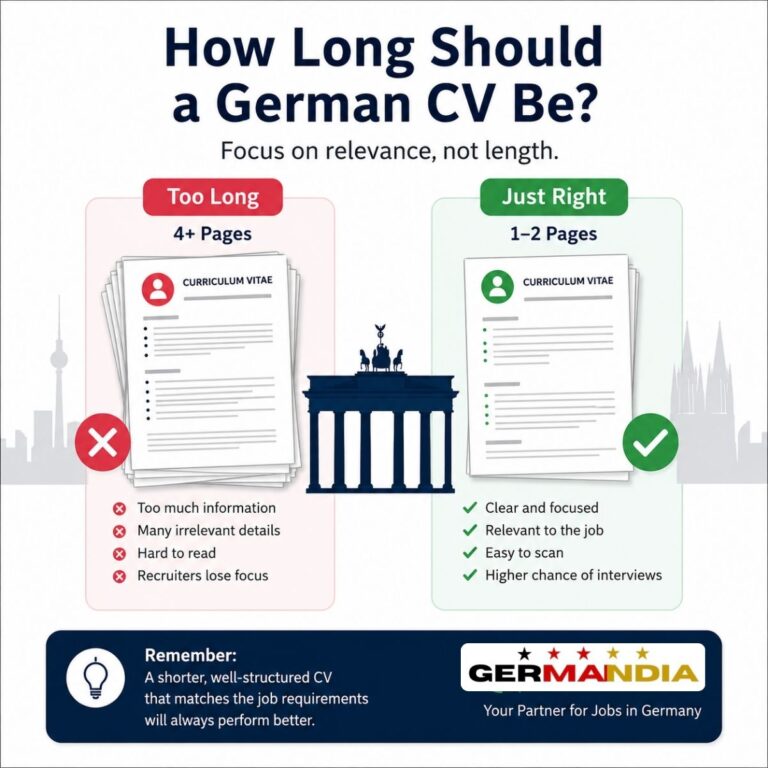
Recruiters may receive many applications for one vacancy. They therefore need to understand your profile quickly.
Your CV should immediately answer three questions:
What do you do?
What are your strongest skills?
Why are you relevant for this particular position?
If those answers are difficult to find, even an experienced candidate can be overlooked.
For a detailed explanation, read Germandia’s Hiring Process in Germany: How It Really Works article.
INTERNER LINK: Hier verlinkst du auf deinen bestehenden Artikel „Hiring Process in Germany: How It Really Works“.
3. How to Get a Job in Germany With a Clear CV
People searching for how to get a job in Germany often focus first on finding more vacancies.
But more vacancies do not automatically lead to more interviews.
Your positioning matters.
A CV that presents you as a software developer, cloud specialist, project manager, data analyst and cybersecurity expert at the same time can make your profile difficult to understand.
Choose a clear target role.
Your headline, professional summary, skills and work experience should support that target.
This is particularly important for experienced professionals. Ten years of experience does not help if the recruiter cannot understand which role you are applying for today.
You can learn more in Germandia’s German CV vs Indian CV: The Complete Guide.
INTERNER LINK: Hier deinen vorhandenen Artikel „German CV vs Indian CV: The Complete Guide“ verlinken.
4. Job Application Tips Germany: Match the Job Description
One of the most useful job application tips Germany candidates can follow is to stop treating every vacancy as interchangeable.
Read the job description before applying.
Look for recurring requirements and distinguish between essential requirements and additional preferences.
Then compare them honestly with your experience.
If a company is looking for a Java backend developer, for example, your CV should not make the recruiter search through unrelated technologies before discovering your Java experience.
Relevant information belongs where it can be seen quickly.
This does not mean copying the job advertisement into your CV. It means presenting your genuine experience in a way that makes its relevance clear.
5. How to Apply in Germany Without Sending a Generic CV
If you are wondering how to apply in Germany more effectively, stop measuring your job search only by the number of applications you send.
Ten targeted applications can be more useful than fifty generic applications.
Before sending an application, check whether your CV communicates the role clearly, whether your most relevant experience is easy to find, whether the required skills appear naturally in your CV and whether unnecessary information distracts from your main profile.
This also matters when companies use an Applicant Tracking System.
An ATS can help companies organize and filter applications, but candidates should not write unnatural CVs simply to satisfy software.
Your application ultimately needs to make sense to a human recruiter.
For more information, read ATS CV Germany: How to Pass Applicant Tracking Systems.
INTERNER LINK: Hier verlinkst du deinen vorhandenen ATS-Artikel.
6. Applying Deutsch: Do You Need German?
People sometimes search Google for phrases such as “applying Deutsch” because they want to know whether applications in Germany need to be written in German.
There is no single answer for every company.
If the vacancy is written in German and German is required for the position, a German application may be appropriate.
If the vacancy and working language are English, an English application can be completely acceptable.
However, German language skills can still broaden your opportunities.
Even in international companies, German may matter when communicating with customers, colleagues, authorities or other departments.
The important point is this: never claim a higher German level than you actually have.
State your language level clearly and keep improving it.
Language is not only an application requirement. It can also affect how confidently you navigate everyday and professional life in Germany.
For more on this topic, read Why German Matters for Your Career in Germany.
INTERNER LINK: Hier verlinkst du deinen vorhandenen Artikel „Why German Matters for Your Career in Germany“.
7. How to Apply for a Job in Germany With a Strong Cover Letter
When learning how to apply for a job in Germany, many candidates focus almost entirely on their CV.
But some employers also request a cover letter.
A German cover letter should not simply repeat your CV. It should explain why you are interested in this particular position, why your experience matches the role and what you can contribute to the company.
Avoid generic statements that could be sent to any employer.
Instead, connect your experience directly to the position.
If a cover letter is requested, keep it focused and relevant.
For a detailed explanation, read German Cover Letter.
INTERNAL LINK: Link to your existing German Cover Letter article.
8. Apply for Jobs in Germany Through the Right Platforms
Knowing how to apply for jobs in Germany also means knowing where to look.
LinkedIn is useful, particularly for international and IT positions. XING can also be worth checking because it remains part of the German-speaking professional market.
Do not rely only on job platforms, though.
Check company career pages directly. If you identify companies that genuinely match your professional background, visit their career sections regularly.
Germany’s official portal for international professionals, Make it in Germany, also provides information about working in Germany, job searching, recognition of qualifications and immigration requirements.
EXTERNAL LINK: Link Make it in Germany to the official German government website.
You can also use the Federal Employment Agency’s job search to explore vacancies.
EXTERNAL LINK: Link this to the official Bundesagentur für Arbeit website.
These are useful external links because they give your readers authoritative sources rather than sending them to random commercial websites.
9. How to Apply in Germany Without Making These Mistakes
If you want to understand how to apply in Germany, avoid a few common mistakes.
Sending the same CV everywhere is one of them.
Another is applying for positions simply because several technologies in the advertisement appear somewhere in your professional history.
Your current target role matters.
Other common problems include an unclear professional profile, irrelevant information taking too much space, important skills being difficult to find, applying without carefully reading the job description and presenting experience without explaining its relevance.
A recruiter should not have to interpret your entire career history to discover why you might fit the vacancy.
Clarity matters.
This is especially important for international professionals whose previous job titles, qualifications or responsibilities may not immediately mean the same thing to a German recruiter.
10. How to Get a Job in Germany: Quality Before Quantity
There is no formula that guarantees how to get a job in Germany.
But you can improve the quality of your job search considerably.
Before submitting your next application, ask yourself:
Does this position genuinely match my experience?
Can a recruiter understand my target role immediately?
Does my CV show the experience required in the job description?
Have I removed information that distracts from my positioning?
Is my application written for this vacancy rather than for every possible vacancy?
This approach takes more time per application.
But the objective is not to send the highest number of applications.
The objective is to get interviews.
How to Apply for Jobs in Germany: A Simple Process
If you want a simple answer to how to apply for jobs in Germany, use this process.
First, define one clear target role.
Second, search for vacancies that genuinely match that role.
Third, read the complete job description before applying.
Fourth, identify the most important requirements.
Fifth, adapt your CV so that your relevant experience is immediately visible.
Sixth, prepare a tailored cover letter when one is requested or useful.
Seventh, check your documents carefully before submitting them.
Finally, keep track of your applications and learn from the results.
If you repeatedly send targeted applications but receive no interviews, do not automatically send more.
Review your CV, positioning and application strategy first.
FAQ: Applying for Jobs in Germany
How do I apply for jobs in Germany?
To apply for jobs in Germany, identify positions that match your qualifications, study the job requirements and tailor your CV to the specific role. Submit the documents requested by the employer through its career website or application system.
How can I get a job in Germany as an international professional?
If you want to know how to get a job in Germany as an international professional, focus on positions matching your actual experience and make your professional profile easy for German recruiters to understand. Language requirements, qualifications and residence or work authorization may also affect which positions are suitable.
Should I apply for a job in Germany in English or German?
Follow the language of the vacancy and the employer’s requirements. If a job advertisement is in German and requires German skills, a German application may be expected. For English-speaking positions, English documents are often appropriate.
How many jobs should I apply for in Germany?
There is no ideal number. Sending many poorly matched applications is unlikely to solve the problem. Concentrate on relevant positions and adapt your application to each vacancy.
Do I need German to work in Germany?
It depends on the profession and employer. Some international IT positions operate primarily in English, while other jobs require German. Improving your German can increase the range of positions available to you and make everyday life easier.
German Is More Than a Job Requirement
German can matter long after the interview is over.
You may need it when speaking with colleagues, dealing with authorities, visiting a doctor, renting an apartment or simply participating in everyday life.
Many learners know considerably more German than they actually speak because they are afraid of making mistakes.
That is exactly the problem I address in my book Speaking German Without Fear (Deutsch sprechen ohne Angst).
If you have been applying repeatedly without getting interviews, the problem may not be your qualifications.
Your CV may simply not communicate your experience in the way German recruiters expect.
Learning how to apply for jobs in Germany is not about discovering a secret trick.
It is about understanding the market.
Know your target role. Read the vacancy carefully. Make your relevant experience visible. Adapt your application. Improve your German where necessary. And choose quality over mass applications.
If an application does not work, do not immediately assume that you need more qualifications.
Sometimes you need to present the qualifications you already have more clearly.
About the Author
Anita Grabowski is the founder of Germandia and supports Indian and international professionals in preparing for and navigating the German job market.
Her work focuses on German CV standards, application strategy, career positioning and practical preparation for professional and everyday life in Germany.
Through Germandia, she helps professionals understand what German employers expect and how to present their experience with greater clarity.
She is also the author of Speaking German Without Fear (Deutsch sprechen ohne Angst), a practical book designed to help German learners overcome their fear of speaking and use the language more confidently in everyday life.
Sources
Bundesagentur für Arbeit – Jobsuche
Bundesagentur für Arbeit – Job finden
Free CV Diagnosis
Not sure whether your CV is ready for the German job market? Start with my free CV Diagnosis and find out what may be holding your application back.
German Job Application Guide
Want to manage your applications yourself? My German Job Application Guide shows you how to approach the German job market step by step.
CV Optimisation Service
If you want professional support, I can optimise your CV for your target role and the German job market.